
The Marangu Route, often called the Coca-Cola Route, is the oldest established path up Mount Kilimanjaro and the only route that offers hut accommodation for the entire climb. Rather than camping, climbers sleep each night in dormitory-style huts with wooden bunks, mattresses, and communal dining halls, following the mountain’s southeastern approach from Marangu Gate.
The nickname dates back to the early years of Kilimanjaro tourism, when Marangu was the mountain’s only commercial route and soft drinks, including Coca-Cola, were sold at the huts, a novelty at the time on a remote mountain. Because it is the only route with permanent huts, Marangu is also the only route where climbers typically ascend and descend along the same path, which means it offers less variety in scenery than routes like Machame or Lemosho, though the rainforest, moorland, and alpine zones it passes through remain genuinely scenic in their own right.
The clearest advantage of the Marangu Route is comfort. Sleeping in a hut with a real bed, rather than a tent on the ground, allows for better rest during the trek, and basic facilities such as flush toilets and running water are available at the lower huts. For climbers who value a more developed trail experience, this is a meaningful difference from the fully camping-based routes.
It’s worth being clear-eyed about one common misconception, however. The nickname “Coca-Cola Route” and its reputation for being the easiest route often lead people to assume it is also the easiest route to summit. In practice, the opposite tends to be true: because the standard itinerary is shorter and follows the same path up and down, Marangu has historically recorded one of the lower summit success rates among Kilimanjaro’s routes, particularly on the five-day version. The mountain’s altitude is the same regardless of which trail is taken, and a rushed ascent increases the risk of altitude-related problems on summit night.
This is precisely why the six-day itinerary, which adds an acclimatization day at Horombo Hut, is strongly recommended over the five-day version. On the extra day, climbers typically hike up toward Mawenzi Ridge, spend time at higher altitude, and then return to sleep at Horombo, following the “climb high, sleep low” principle that helps the body adjust before the final push. This single addition significantly improves a climber’s chances of reaching Uhuru Peak compared to the compressed five-day schedule.
Beyond the huts and the acclimatization structure, Marangu passes through several distinct climate zones, from dense rainforest, home to blue monkeys and colobus monkeys, into open moorland with views of Mawenzi Peak, and finally into alpine desert and the arctic summit zone. As with every Kilimanjaro route, summit night itself remains demanding regardless of how the earlier days were spent, involving steep scree in the dark and very cold temperatures, but arriving at Kibo Hut well-rested after real sleep does give Marangu climbers a genuine advantage heading into that final stretch.
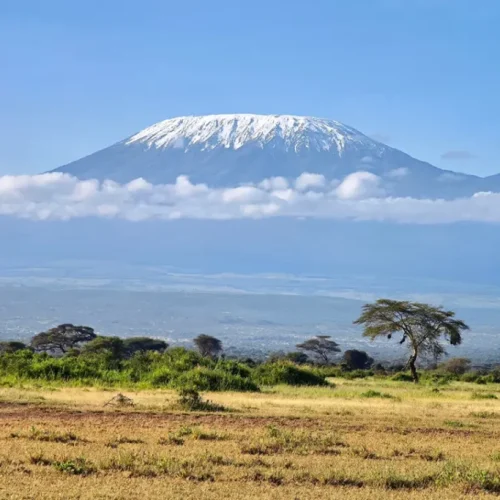
The trek begins at Marangu Gate, on the southeastern side of the mountain at approximately 1,860 to 1,870 meters (6,100 feet), a drive of about 45 minutes to an hour from Moshi. The total distance covered is approximately 72 kilometers (45 miles) round trip, gaining more than 4,000 meters in altitude from gate to summit. Climbers spend five to six days on the mountain, with the six-day option including the extra acclimatization day at Horombo strongly preferred by most operators.
On the first day, the trail passes through rainforest to reach Mandara Hut at around 2,700 meters (8,860 feet), a walk of roughly three to four hours. The second day continues through the remaining forest before opening into moorland, reaching Horombo Hut at approximately 3,720 meters (12,200 feet) after five to seven hours of walking. Horombo is the largest camp on the route, with capacity for well over a hundred climbers, multiple hut clusters, a dining hall, and solar-powered lighting. On the six-day itinerary, the third day is spent on the acclimatization hike toward Mawenzi Ridge before returning to Horombo for a second night. The following day continues to Kibo Hut at around 4,700 meters (15,420 feet), the staging point for the summit attempt.
Summit night begins in the early hours of the morning, climbing via Gilman’s Point at roughly 5,700 meters (18,700 feet) before continuing along the crater rim to Uhuru Peak at 5,895 meters (19,340 feet). After time at the summit, climbers descend all the way back down to Horombo Hut on the same day, before a final descent to Marangu Gate on the last day of the trek.
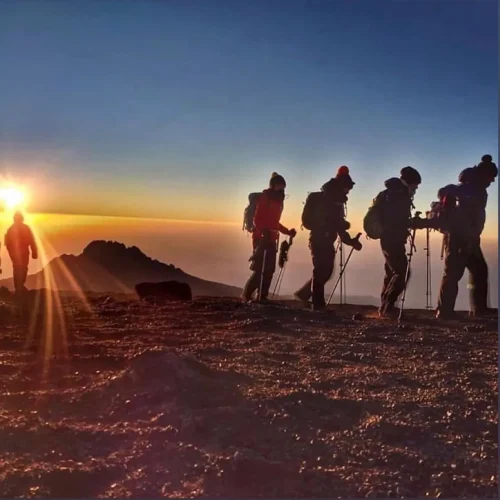
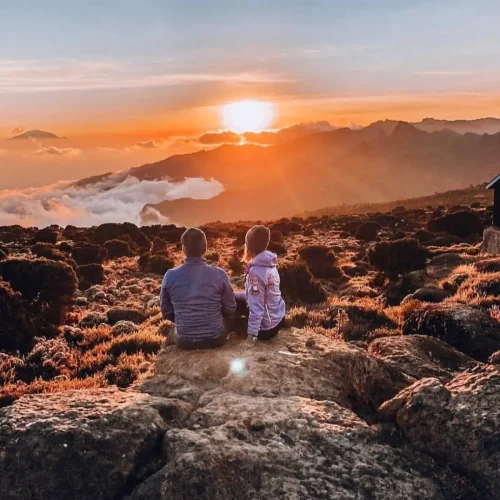
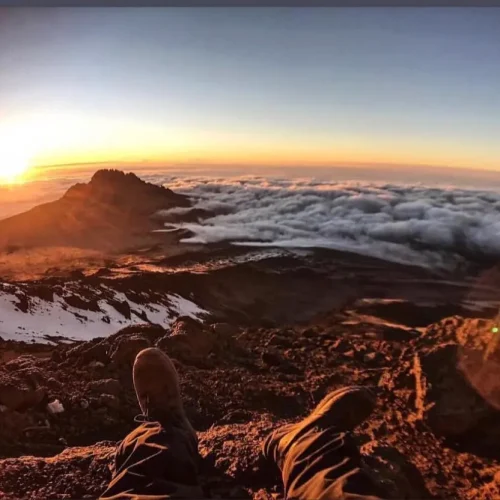
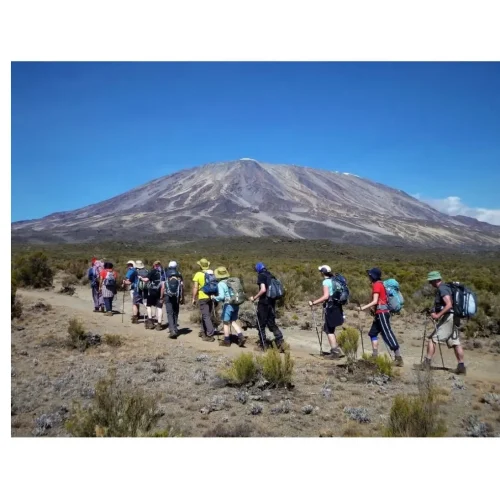
January through March brings the warmest temperatures, the clearest summit views, and generally lighter crowds. June through October is the classic dry season, with the most dependable weather, though it is also the busiest period on the mountain. December through February offers excellent conditions with somewhat fewer climbers than the peak dry months.
Climbers should be prepared for wet trails and reduced visibility during the long rainy season from April to May, unless specifically equipped for those conditions.
As an Arusha-based, locally owned operator, we know Kilimanjaro closely. Many of our guides were born in the villages surrounding the mountain and understand its weather shifts and pacing requirements in detail, along with exactly how to keep climbers safe and strong from gate to summit.
We keep groups small for personal attention, pay fair wages and provide good working conditions for our full mountain crew, including porters, cooks, and assistant guides, and follow responsible tourism practices to help protect this UNESCO World Heritage site.
Travelers choose us for genuine Tanzanian hospitality, direct support from our Arusha office, flexible trip customization, and a real commitment to safe, well-paced summits.
The Marangu Route combines hut-based comfort, a historic path up the mountain, and, on the six-day itinerary, a solid acclimatization structure, making it a rewarding way to stand on top of Africa for climbers who value rest and a more developed trail experience.
Contact us today for a free personalized quote, a detailed gear list, training advice, or to combine your climb with a Serengeti or Ngorongoro safari.
The Kilimanjaro Marangu Route is one of the established routes for climbing Mount Kilimanjaro. It approaches the mountain from the southeastern side and is known for its mountain hut accommodation rather than camping. The route uses huts at Mandara, Horombo, and Kibo, making it a popular option for trekkers who prefer sleeping indoors during the climb. Tanzania National Parks confirms these hut facilities along the Marangu route.
The Marangu Route can be completed in different durations, with 5-day and 6-day itineraries commonly offered. A longer itinerary is generally preferable because it provides more time for acclimatization before the summit attempt. Tanzania National Parks notes that visitors are ordinarily required to spend at least five days ascending and descending Kibo for acclimatization purposes.
Yes. Although the Marangu Route is sometimes called the easier Kilimanjaro route because of its gradual trail and hut accommodation, reaching Uhuru Peak at 5,895 metres remains physically demanding. The main challenge is altitude, particularly during the summit ascent from Kibo Hut. Good fitness, steady pacing, proper hydration, and adequate acclimatization are important.
Trekkers on the Kilimanjaro Marangu Route sleep in mountain huts rather than tents. The main overnight stations are Mandara Hut, Horombo Hut, and Kibo Hut. The hut system is one of the main differences between Marangu and routes such as Machame, Lemosho, and the Northern Circuit, where camping is normally used.
The Marangu Route provides a gradual approach to higher elevations, but its shorter itineraries allow less acclimatization time than some longer Kilimanjaro routes. For this reason, trekkers who have enough time may prefer a 6-day Marangu Route rather than rushing the climb in five days. Spending an additional night at Horombo can provide more time to adjust before continuing toward Kibo.
The Marangu Route can be climbed throughout the year, but the generally drier periods are often preferred for better trekking conditions. The main seasons to consider are the dry periods around June to October and January to February. Weather can change quickly on Kilimanjaro, so trekkers should prepare for rain in the forest, cold temperatures at higher elevations, and freezing conditions around the summit regardless of the season.
You should bring good hiking boots, lightweight trekking clothes, thermal layers, a waterproof jacket and trousers, warm summit clothing, gloves, a warm hat, headlamp, sunglasses, sunscreen, water bottles or a hydration system, personal medication, and a suitable daypack. Because the Marangu Route uses huts, you do not need to carry camping equipment such as a personal tent. Kiwoito Africa Safari can provide a complete Kilimanjaro Marangu Route packing list before your trek.
Visa requirements depend on your nationality. Travelers who require a Tanzanian tourist visa can apply through the official Tanzania Immigration eVisa system. Eligible travelers may also obtain a visa on arrival at an official entry point, although Tanzania Immigration recommends applying online. Travelers should have a passport with at least six months of validity and an unused visa page. Immigration may also request evidence of a return or onward ticket and sufficient funds for the stay.
The Marangu Route is a well-established Kilimanjaro trekking route, but climbing to nearly 5,900 metres still involves risks associated with altitude, weather, cold, fatigue, and difficult terrain. Trekkers should use experienced mountain guides, follow a slow and steady pace, stay hydrated, and immediately report symptoms such as severe headache, dizziness, nausea, unusual weakness, or breathing difficulties. Travel insurance that covers mountain trekking and emergency evacuation is also recommended.
Kiwoito Africa Safari can organize your Kilimanjaro Marangu Route trek with experienced mountain guides, park arrangements, hut accommodation, meals, transfers, and mountain crew support according to your selected package. Marangu is a good option for travelers who prefer hut accommodation, a well-established trail, and a direct route toward the summit. Kiwoito Africa Safari can also combine your Kilimanjaro trek with a Tanzania safari or Zanzibar beach holiday.